The new rules of longevity — 9 transformations that are redesigning our way of living
The new rules of longevity — 9 transformations that are redesigning our way of living
↗ Health and wellness
Living longer is changing the rules of how we live. It challenges the way we organise our life stages, understand work, shape our identities, take care of our health and connect with other generations.
Yet many of the social, economic and cultural structures around us still reflect a model of life that is becoming increasingly outdated.
At dot. we have spent years exploring this transformation alongside organisations, research centres and social innovation stakeholders. Our work draws on exchanges with international leaders such as MIT AgeLab, Stanford Center on Longevity and Nordic Welfare, as well as the work of social entrepreneurs from Ashoka's global network (including Sergio Serapiao (BR), Alejandro Marius (VZ), Mireya Vargas (VZ), Lorenzo Marini (IT)). We also draw inspiration from initiatives closer to home, such as Adinberri and Sasoiko, an initiative of the BBK Foundation.
This journey has allowed us to identify nine major transformations that are shaping a new understanding of longevity. Nine key shifts that not only reveal where we are heading, but also uncover emerging tensions and opportunities to redesign our model of society.
"Longevity is going to change almost every aspect of our lives."
Our understanding of longevity is shifting towards a continuous process that concerns people of all ages, rather than being limited to the final stage of life. This transformation reshapes every decision we make and reconfigures each stage of our lives: How and when do we learn? How do we work? When do we provide care? How do we build relationships? When do we embark on new life projects?
New Longevity is therefore much more than a new term. It calls for a fundamental rethinking of the entire life course, moving beyond the traditional linear model towards longer, more diverse and non-sequential life paths. In this context, the question is no longer how to live more years in old age, but how we design longer lives from the very beginning.
For decades, ageing has been approached through a deficit-based lens: declining abilities, dependency, social costs and increasing pressure on public systems. However, the most progressive international frameworks point towards a shift in perspective: longevity also represents an opportunity for social, economic and community engagement.
The New Longevity approach recognises older adults as active contributors who can continue to add value to society through work, volunteering, caregiving or knowledge sharing. Initiatives led by Ashoka's social entrepreneurs place particular emphasis on this dimension, promoting lifelong contribution and the value of intergenerational relationships.
One of the greatest shortcomings of traditional approaches has been treating older people as a homogeneous group. Yet the reality is radically different: the population aged over 55 encompasses a wide range of life situations, from people who are still working to those who have already retired, with vastly different financial circumstances, health conditions, social networks and expectations. This diversity is also shaped by factors such as gender, culture and socioeconomic status, which significantly influence individual life trajectories.
Recognising this diversity is essential to designing effective responses. New Longevity cannot be addressed through one-size-fits-all solutions, but requires flexible, personalised approaches that reflect the diversity of people's experiences.
Longevity is giving rise to increasingly fragmented life trajectories, in which people move through multiple stages, combining learning, work, caregiving, rest and reinvention over several decades.
This brings new types of transitions: career changes, periods of time off, returning to education or gradual retirement. Life is no longer a straight line, but a dynamic journey involving constant movement between different roles. In this context, the ability to navigate these transitions, rather than reaching a particular final destination, becomes one of the most important skills for living a long life.
Where identity was once closely tied to a particular profession, longevity introduces the need to redefine ourselves repeatedly throughout life. People are no longer just one thing for their entire lives. They evolve, take on new roles and reconstruct their sense of identity at different moments.
Transitions such as retirement, career changes or new caregiving responsibilities can bring uncertainty or a loss of direction. One of the major challenges of New Longevity is therefore supporting people through these processes of reinvention, providing tools, spaces and narratives that help them sustain a flexible, coherent and adaptable sense of identity over time.
Population ageing is not merely a demographic phenomenon, but a large-scale economic transformation. In Spain, people aged over 55 already represent 34% of the population (more than 16.7 million people) and account for a growing share of the country's economic power.
This group is not only large, but also a driving force in the economy: it generates around 60% of consumer spending and nearly 25% of national GDP, making it one of today's key economic engines. Furthermore, projections suggest that Spain will become one of the world's oldest countries, with up to 40% of its population aged over 60 by 2040, further amplifying this economic impact.
The global consumption expenditure of people over 60 years of age will go from 19 trillion dollars in 2026 to 34 trillion dollars in 2036, which represents growth close to 80% and will make this group concentrate almost a third of global consumption.

New Longevity embraces a holistic vision of wellbeing that includes physical, emotional, social and cognitive dimensions, recognising that living well depends on multiple interconnected factors.
Public space →
Accessible and safe streets and buildings
Transportation →
Ease of movement and autonomy
Housing →
Adaptable and connected homes
Social relations →
Activities to continue being part of
Inclusion →
Respect, visibility and non-discrimination
Civic participation →
Opportunities to contribute
Information →
Clear and accessible communication
Care and health →
Close and coordinated services
In this context, the goal is not simply to prevent or treat illness, but to ensure that people can maintain their autonomy and continue doing the things that give meaning to their lives. The focus therefore shifts towards how we experience those additional years: with capacity, independence and good quality of life sustained over time.
Most products, services and experiences have been designed around a "standard" user who no longer reflects the true diversity of society. From household appliances to digital interfaces, public services and consumer experiences, many environments fail to consider the evolving needs associated with age, such as accessibility, usability and adaptation to different abilities.
Longevity is driving new solutions across sectors such as tourism, banking and mobility. Far from representing a niche market, it is a cross-sector transformation that invites us to rethink how we design products and services for a society in which we are living increasingly longer lives.

The quality of our social relationships is becoming a decisive factor in wellbeing. Unwanted loneliness, isolation and age-based segregation can no longer be understood as individual problems, but as systemic risks affecting health, social cohesion and the sustainability of communities.
In response, social connection is increasingly recognised as essential infrastructure, on a par with healthcare or education. Creating spaces for connection, fostering intergenerational relationships and strengthening community networks are becoming fundamental to supporting long, active and meaningful lives.
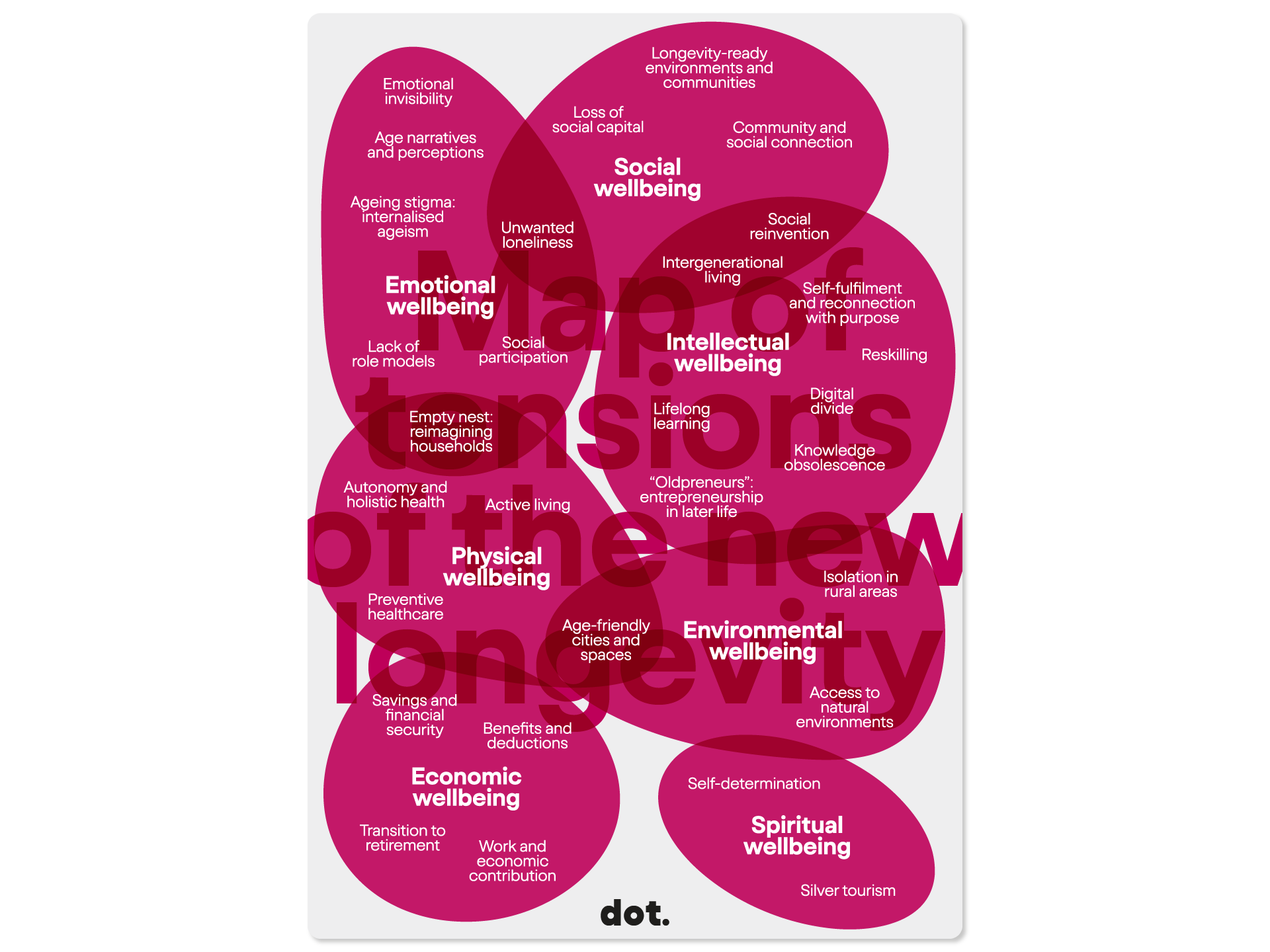
Through our ongoing research and work in these areas, we have observed the emergence of a new map of tensions associated with New Longevity, adding a distinctive and complementary layer to the challenges traditionally addressed within the ageing framework.
This map brings together interconnected challenges, which we have organised around the WHO's holistic understanding of wellbeing.
↗ Source: dot.